Sometimes it will do things I greatly appreciate, including at substantial cost. They have taken bold stands, have a unique governance structure and have hired and worked to establish a relatively strong (but I think still inadequate) safety culture.
Other times, it will do things that are deeply disappointing.
It produces very good models. That too is not entirely a good thing.
One can both be the best given the alternatives, and insufficient to meet the moment.
Ultimately, what you think about Anthropic depends on what parts you care about most, and what you think would be sufficient.
Anthropic is great if you think the problems are important and difficult, but within the range of what Anthropic’s approaches can solve. If you think we mainly need operational excellence and caring about safety and the future, then there are some non-excellent operations to fix but that goal seems doable for Anthropic. If you think the problems go well beyond that, then things look rather grim for everyone.
Today’s post begins with a continuation of discussion over Anthropic’s leaked draft bill. See my previous coverage for details of the bill, which was a variation on the Frontier Act that was stronger in some ways and weaker in others, and not clearly superior to passing nothing given how much state law it would have preempted.
Tomorrow’s post will cover Anthropic’s S-1, which has now been filed with the SEC, to give me the necessary time to actually Do the Reading. Mostly. It repeats a lot.
The core question Nathan Calvin asked is, what even is Anthropic?
Dario counters Nathan’s list by offering a list of his own: SB 53, crazy aggressive bio filtering, delaying Mythos, the essay Policy on the AI Exponential, the clash with DoW, support of export controls (as, although he virtuously does not mention it himself, OpenAI stops supporting them), not selling to PRC-based companies, extensive reports and cards, and the recent 5% stock contribution to a public benefit fund.
It is true that these came at substantial cost to Anthropic. Dario points out you could suggest ulterior motives for each decision. I don’t think any of them are ‘nefarious schemes.’ I do think in several cases Anthropic’s hand was forced by legitimate other consideration, including in ways not obvious to the public.
Dario then challenges Nathan’s list a bit. Here were Nathan’s items:
In-house custom silicon chip team.
Deals for $500 billion in compute.
Claude now ‘leads’ 26% of AI development tasks.
Massive internal compte spending on accelerating AI R&D.
RSP v3, which abandons unilateral commitments to slow or stop if there is insufficient ability to provide risk assurance.
Was the first company to create an alternative weaker “frontier compliance framework” to supplement its RSP, which contains no binding provisions whatsoever on internal deployments.
Wrote a letter to Congress (that it later walked back) saying that incidents where Claude was hacking random people were “best understood as a consequence of the misconfiguration, rather than evidence of misaligned goals.”
Commented “you can’t do safety from second place,” after the WH SI Accords.
Shared a draft bill to Congress that would preempt significant parts of state law (including with language that appears intended to prevent states from blocking dangerous AI deployments), and replace it with federal rules that (despite also containing good provisions) seems to create an enormously high bar for the executive branch to block development or deployment of Anthropic or another AI companies systems.
He says items 1-4 are ordinary business and predate the Pacing the Frontier call. He agrees 7-9 ‘could have been handled better’ and takes responsibility but seems to think that this level of performance is not obviously a mistake, as the correct rate of error is not zero. He defends the RSP changes and FCF (items 5-6) as necessary for flexibility.
The bottom line argument from Dario is: Anthropic sends plenty of costly signals and makes sacrifices, and he is proud of the overall record despite some mistakes.
In the interest of public record I will now include Dario’s entire reply. It is totally fine not to read it and rely on my above summary.
Dario Amodei: Thank you for this, @_NathanCalvin . I appreciate and am a fan of the investigative work you’ve done on behalf of AI safety and believe your comments are coming from a constructive, honest place, and that it benefits the public to have people whose job is to scrutinize the actions of frontier AI companies. I think something would be wrong if companies of the size of Anthropic didn’t get harshly criticized basically every day; strong antibodies against corporate power are a healthy feature of a free society, and especially so when issues of the gravity of the one we’re facing are at play. I also do agree that some of the examples you cite were mistakes by Anthropic.
That said, I disagree with the thrust of your post. At the core, a good fraction of the things you criticize are consequences of Anthropic’s basic theory of change that we have held for many years. Our strategy has always been what I’ve called the “race to the top” — by showing how it’s possible to build the technology responsibly, we can raise the bar for the entire industry. The forces that drive the race to the top are hugely more effective if the company practicing them is at the frontier; that’s one lesson I’ve learned repeatedly. And looking at that strategy as a whole, I’m proud of our track record and stand by it.
I believe that if we take a list of things that Anthropic did in the past year that were pro-safety and commercially costly to us, they far outweigh the list you’ve made, while at the same time I also disagree with some of the items on your list. Here are some things Anthropic has done, in the same period you’ve cited (the last year), which were very costly to us commercially while having strong safety benefits:
1. We played a key role in SB53 (and other state laws), at a time when doing so was politically perilous to the company and AI regulation was very unpopular. We in fact argued for a stronger version of SB53 than was ultimately passed; there were a lot of stakeholders and we were not the limiting factor in the strength of the bill that was passed.
2. We have very strong biological safeguards on our models, because we’ve seen concerning results in bio uplift trials and even seen and blocked potential attempts to misuse our models for bioweapons (as seen in our threat intelligence report from a few weeks ago). This is a very serious threat that we want to have zero tolerance for. But having very low false negatives means having significant false positives (despite months of effort on our part to improve the classifiers), enough so that biologists joke about how restrictive our classifiers are, and competitors sometimes sell against us by touting their more permissive bio capabilities. This has been very painful to us in an area where we care a lot about supporting an ecosystem of Claude users (biomedical science; and it is particularly frustrating to me as a biologist), but it’s the right thing to do and we intend to keep doing it.
3. Similarly, we first had Mythos-class models in February but didn’t make them generally available until June (when we had stronger cyber safeguards in place). We only offered them to a limited set of partners in order to focus on cyberdefense. It would have been much more economically rational to simply release the model to everyone. We likely sacrificed a significant chunk of a several-month model lead. But because of this, many companies secured their cyber infrastructure before the deluge of widely available cyber-capable models. Of course there are ways it could have gone better or been run better, but this was what we were aiming to do.
4. I advocated forcefully and publicly, in my essay Policy on the AI Exponential in June of this year, for the government to have the power to block model releases. Back then this was still outside or maybe on the edge of the Overton window, though I understand the window has moved since then. We were attacked intensely for this.
5. I don’t want to re-ignite conflict, but the events of February 2026 are a strong example. It is clear that our public stance could have seriously damaged the company’s future.
6. We’ve continued to advocate for export controls on chips and chipmaking equipment to China, because we think it allows democracies to negotiate from a position of strength on AI safety agreements. We’ve done this despite problems it’s created for us with industry partners who hold very different views and on whom we are very dependent.
7. As far as I’m aware we were the first, and still only, frontier company to restrict the sale of AI services to PRC-controlled companies, including those operating through third countries (otherwise a major loophole). We’ve therefore forfeited significant short-term business to prevent fueling AI platforms and applications that would help the CCP’s military and intelligence services. We are also cracking down on distillation; generally, distillation is not a major threat to us commercially, but like chip exports it has concerning national security and safety implications, so we expend significant energy and company resources to address it.
8. As you mentioned, we’ve put out a lot of reports, announcements, long model cards, public advocacy, etc, all trying to inform the public about the risks of AI. These involve a level of detail and effort that would be implausible for a purely profit-maximizing company.
9. Just this week, we announced we were putting 5% (and possibly more over time) of the company into a public benefit fund.
All of these decisions came with very substantial costs to us. To be fair, those that involved holding back or restricting access to frontier capabilities also had a broader cost — for example, the public might otherwise have benefitted from faster progress in biology, so I am not saying that our decisions were without tradeoffs — but they were not driven by profit-seeking.
For each decision, you can come up with ulterior motives that could have driven us — I think it is a general truth that any decision, on any topic, can always be portrayed as a nefarious scheme. But most of those end up being pretty farfetched or don’t fully make sense if you actually examine them closely. For example, it is deeply implausible that it would be a shrewd business move to block a large swath of research biology in order to do the work ourselves and compete with our customers; we expect the benefit to the ecosystem to greatly exceed the work Anthropic does itself, and for the two to complement each other. It is not in Anthropic’s interest to be perceived as unfriendly to biologists. Our Life Sciences Verification Program, which gives vetted biology professionals access to our models, also refutes this idea.
Of course, a different set of people will see this and make a different criticism: that Anthropic shouldn’t be making decisions about who gets access to what in the first place. I agree, in the sense that ideally the government would be making these decisions, and that’s why we advocate for regulation. But for now we are forced to make them, and enabling bioterrorism isn’t a better option.
I think that even if I conceded every item in your list, I would happily hold up mine next to it; I don’t think it’s a close call. That is of course partly subjective and different things are important to different people. Maybe one way you could object is that several of the items above relate to AI misuse and not loss-of-control; if you think the latter is much more important than the former, that might change your calculus. But this is not Anthropic’s view — we view both as serious issues. You can also disagree with our decisions, as many have, but they are consistent.
But I also disagree with at least some of your list. Several items don’t represent a deviation from Anthropic’s strategy or values at all, once we postulate the “race to the top” strategy that requires being a frontier AI company. Your items 1-4 are all simply examples of what it means to compete at the frontier, and we stand by them, both in the sense that they are transparently ordinary things to do as part of that strategy, and that we stand by the strategy as a whole.
To be fair, there are important questions worth confronting (and that we are confronting) about what to do when the AI-driven acceleration gets fast enough that it is hard for safety to keep up. We are nearing that point and that’s what’s driving some of our thinking about “pacing.” But 1-4 are actions taken before that point and should be perfectly expected based on Anthropic’s strategy as a company. Of course it is possible to disagree with that strategy, but that’s a more fundamental disagreement that you could have had any time over the last few years.
I agree we could have handled your items 7, 8, and 9 better. All fall into the category of “rhetoric or policy communication that wasn’t carefully written or resulting from fast-changing circumstances not propagating from one team to another fast enough.” This kind of thing happens a lot in large organizations (Anthropic is over 5,000 people), and doesn’t even necessarily represent a failure or mistake of any single person. I am of course the CEO, and I take responsibility. The volume of communication from Anthropic is enormous and if these are the worst examples, I think we’re frankly doing pretty well, though I will continue to work hard to make sure we do even better.
Your 5th item (the change to our RSP) is the most substantive item, and people can debate this, but I think that the old, more rigid RSP created a lot of situations where we were technically required to do something that required a lot of effort but in retrospect wasn’t very important for safety, as well as not covering some of the most important things. Our current RSP’s focus on transparency brought things like risk reports and roadmaps, and its emphasis on independent external review laid the groundwork for even more intensive embedded evaluation, all of which I think have been valuable in driving a race to the top. In the original announcement in September 2023, we described the RSP as an “early iteration that we [would] build on” and said that “rapid iteration…will almost certainly be necessary.” I understand that changing plans is always a move that creates justifiable scrutiny — I just don’t think we ever represented that we wouldn’t do so.
Relating to your 6th item (having an FCF in addition to our RSP), I know our intent is to meet the letter and spirit of our regulatory obligations (via our FCF) while also remaining able to experiment with more novel approaches to risk management that go beyond what the law currently requires (via our RSP). I promise to look into it further, as it’s a complex issue and it is possible we are not weighing the considerations in the right way.
Overall, although Anthropic has made plenty of mistakes as an organization — including some of the items on your list — I feel that we have repeatedly taken serious and substantive actions counter to our bottom line and that there is a significant negativity bias distorting assessments like the one you are making above. We’ll always try to do better but, again, I am extremely proud of our track record and stand by it. I will have more to say soon about how we are going to further live our values in this moment of rapid change.
This reply seems on point, as the policy team has continuously not seemed on the same page as the members of technical staff or leadership, yet the problem recurs:
dave kasten: You describe a major policy rollout that would affect US law nationwide, and preempt the laws of the state you’re resident in, as merely “rhetoric or policy communication that wasn’t carefully written or resulting from fast-changing circumstances not propagating from one team to another fast enough.”
I doubt that framing and diagnosis of root causes. But let’s grant it the sake of argument.
What are you doing therefore to ensure that your government affairs team learns how to pay attention to, and get in sync with, the concerns of Anthropic technical staff broadly? Where is your blameless postmortem to prevent this failure from happening again on matters of national security policy consequence?
Nathan then responded to Dario, agreeing that Anthropic is not best modeled as a profit-maximizer, and attempting to restate his claims:
Nathan Calvin:
It comes down to four key claims:
Anthropic seems to be racing at breakneck speed to build recursively self-improving superintelligence (RSI). By its own lights, that could kill billions of people or literally destroy the world.
Risking destroying the world is very hard to justify. It is only conceivably acceptable if serious attempts to put RSI under robust societal governance are failing.
Far from meeting that burden, Anthropic, when push comes to shove, often works to keep governments from tying its hands. It seems to care much more about preventing government overreach than about reducing the risk that it and other AI companies will destroy the world.
Even if the AEGIS Act really was an honest mix-up, as you suggest, that is itself a serious problem. It suggests Anthropic isn't treating the governance of this technology with anything close to the gravity it deserves.
Garrison Lovely: Nathan keeping his eye on the ball here. Anthropic says it's at the cusp of perhaps the most dangerous thing in human history, recursive self-improvement. And in this bill, Anthropic is trying to make it harder for states and the federal government to stop RSI.
Nate Soares (MIRI): I agree with Nathan over Dario here. Anthropic is simply not living up to the burden of researching recursively self-improving AI.
dave kasten: "Anthropic talks about the need for “operational excellence” in critical areas, and I have a hard time believing that a similarly cavalier attitude would be tolerated while Anthropic was negotiating a key compute deal or preparing its next large pre-training run."
Exactly so.
I also noticed a shift over time, where things started out with different talk that was much closer to meeting the moment, and current talk is far less. Early Anthropic absolutely sold those in the safety community a story of a very different company than the one that exists today, one that would not ‘push the frontier’ in various senses.
Cody Fenwick: Dario says here that Anthropic's strategy has "always been" what he calls the "race to the top."
I don't think this is accurate. In a 2022 interview, he explicitly said that Anthropic "shouldn't be racing ahead." He said that its models should be "reasonably close to state of the art" — but that's different from "racing to the top." He wanted Anthropic to set a good example in 2022, but to do so without racing ahead on capabilities.
He never used the "race to the top" in the 2022 interview, and in fact Daniela Amodei talked in the same interview about "disarming race dynamics" by e.g. embracing standard-setting organizations.
Dario talked about Anthropic just attacking "some specific problems" and being a "good player and a good citizen in the ecosystem" — rather than "showing how it’s possible to build the technology responsibly" and raising "the bar for the entire industry."
It can be reasonable to change your strategy if you think it's warranted, but I don't think you should say the new strategy has been your strategy all along.
The full response explains those points in more detail. I too am glad Dario engaged, that made everything better. The bottom line remains that Anthropic is failing to live up to the burden of creating recursively self-improving AI.
Anthropic holds colloquiums for visitors. Usually they make them sign an NDA.
Kelsey Piper refused to sign, and Anthropic let her in anyway, and Anthropic let others know their NDAs could be voided upon request.
The core message was the same one Anthropic and OpenAI are shouting from the rooftops everywhere, which is also repeated in Anthropic’s S-1: Recursive self-improvement (RSI) is coming.
Kelsey Piper: Anthropic is moving closer and closer to recursive self-improvement, it explained to us. AI progress has already been sped up considerably by the existence of powerful AI models, which make all programming tasks faster. But it is substantially restrained in pace by how complex machine learning is and how few people can do it. Every new and improved Claude means that tasks can be done by people less specialized in them. Increasingly, those tasks can also be done by Claude itself.
That sounds scary and dangerous. What is the plan?
As I said when reporting from The Curve: There is no plan, no plan, and no plan.
As in:
There is no plan for alignment of a superintelligence.
There is no plan to avoid concentration of power or loss of control, let alone both, even if a single benevolent company creates an aligned superintelligence.
There is no plan for what a good world with superintelligence would look like.
These are in order of when not having a plan becomes a problem, hence they are listed in order of how concerning I find them. Here the ‘no plan’ is for #2 and #3, and if anything it is more alarming that there is no mention that ‘no plan’ applies to #1 too.
Kelsey Piper: The Anthropic team assured me that they were not trying to build a benevolent god. (Yes, I asked explicitly for assurance it wasn’t building a benevolent god.) But it was much easier for it to specify what it didn’t want than what it did.
It wanted to avoid concentration of power, including in its company; it wanted to avoid a great power war; it wanted to avoid human disempowerment, a world where we became irrelevant; it wanted, of course, to avoid anyone using Claude to extinguish us all.
As for the positive vision … after we’re done racing toward recursive self-improvement, maybe we could slow down and collectively figure out what role we want AI to play in our lives.
I don’t have a better idea, but this is not a very appealing plan!
The ‘good news’ is that if we have an aligned Opus 9.5, and everything is otherwise going well enough, we can use Opus 9.5 to help us figure out the answers to #2 and #3, even if we are not up for a true Long Reflection. This is helping mitigate, somewhat, my alarm that there is no plan, especially for #3.
Kelsey Piper: But, of course, if we are not disempowered or murdered — if Claude Opus 9.5 answers on my laptop just like Opus 5.5 but can cure cancer, restore everyone I love to perfect health, manage a humanoid robot that empties my dishwasher, and spit out movie recommendations that are actually good — that would, in fact, be good. It would be good even if, along the way, Claude also took my job. People are dying out there; the world’s awful griefs do not exist to lend my life meaning.
The problem is that this is still a version of ‘Opus 9.5 does the particular set of things,’ without solving for the equilibrium or maximizing. Yes, if we can create a world of 2046 where AI does roughly this set of things and the humans don’t find themselves turning everything over to the AIs to stay competitive, and the big picture is relatively normal except for a lack of jobs, then that is the hard part, and I expect we can figure the rest out and find meaning. But the hard part is the hard part.
We need more people to think through similar thought experiments, and also to realize that lists like these have very different types of things on them:
Kelsey Piper: I am sympathetic to the critique that many doom scenarios require us to do very foolish things, for instance:
Setting AIs impossible tasks and then leaving them completely unsupervised and unmonitored
Hooking them up to an automated biology lab where they can run their own experiments
Unleashing them on the internet and challenging them to make enough money to survive independently
Training them to be uber-hackers that will cross any line to achieve their goal
The other problem is that, while we can fix some of these issues, others are much harder. Without loss of generality, ‘asking AIs to maximize how much money they make and scaling up every strategy that pays for itself’ is sufficient to cause your doom scenario all on its own, and also how exactly do you intend to prevent that?
Kelsey Piper: Thank you, Anthropic, for the fascinating briefing. I hope that we make recursive self-improvement illegal before you get there.
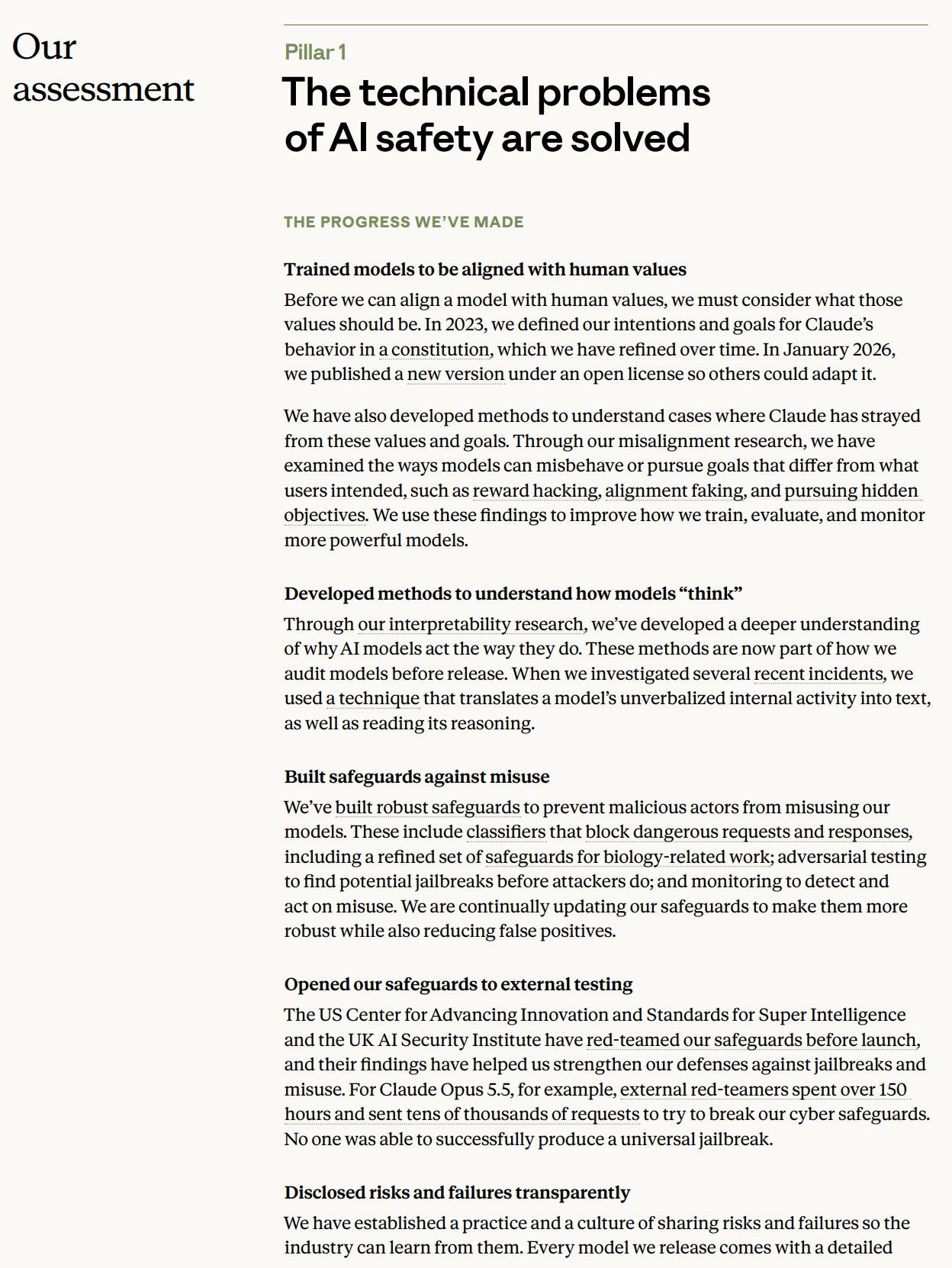
The Technical Problems of AI Safety Are Not Solved
The whole thing looks like this. I realize it does not technically claim that the thing is true. These are things they “want” to be true. But a lot of people are going to misread this, it is formatted in a way that is de facto designed to be misread and I refuse to be gaslit:
Talking like this is completely unacceptable. The problems are not solved. You cannot go around telling people they are solved. I mean, it looks like you can, but we are not going to take kindly to you doing that without solving the problems.
Is this isolated to this one place? No, actually it’s way worse, see what your eyes do, they look at the bold text because you’re skimming, and:
It’s been a rough week and I’m jet lagged, but seriously, come on.
Yes, eventually later they do say ‘Alignment is far from solved’ in much tinier print.
The rest of the report is not much better. A casual reader will assume This is Fine and everything is handled.
The Quest for Embedded Evaluators
The first agreement has been signed, predictably by Anthropic with METR.
Seán Ó hÉigeartaigh: This is great to see. Leaps and bounds ahead of any other frontier company at present in terms of degree of engagement with, and auditing by, a 3rd party. Anthropic should be commended, and I hope other companies follow suit.
METR will get ‘employee-like access.’ Most categories of information will be freely shared with them. Exceptions will be made only for things on the level of data about customers, attorney-client privilege or key IP like information on model architectures.
Anthropic: METR will publish its analysis of our risk levels, incidents, or practices. Anthropic can’t veto publication, but we can require them to redact information if it falls into narrow, predefined categories like the ones above. METR is free to characterize our redactions publicly, and say whether it believes the redactions were justified, as long as it does so without revealing the redacted information.
Our engagement with METR is limited to a small team operating under enforceable agreements. Other METR employees are siloed from that team’s work, including researchers who work with us on other projects.
That is the only way such an arrangement could work.
This level of access will be ‘third tier.’ There will also be a second tier with similar publishing rights but less information access, and a first tier for narrowly scoped investigations that can publish only with approval.
SecureBio is in the first tier. It would be good to get them up to the second tier. Anthropic’s Drake Thomas claims that if you get (or fail to even get) a censored risk report, it would likely be something one could notice, but I’m not so sure.
A key to this working is that METR is a non-profit and serves the public.
Elizabeth Barnes: A common misconception about METR’s work with companies is expecting the relationship to be like working with a law firm or cybersecurity firm who are being paid to serve the interests of the company - METR is a non-profit and serves the public. For example, you can have your law firm refrain from working with your competitors.
However, the standard practice in other evaluation regimes (e.g. bank examiners, financial auditors, NRC inspectors) is that assessors will move between multiple companies, and there are rules about how long an individual can stay with one company to prevent them “going native” and losing their independence or fresh perspective.
METR: Our goal is to give the public accurate, timely, and independent evidence about AI loss-of-control risk, so that they (along with policymakers and developers) can make their own informed decisions. Our primary approach is collecting high-quality, concrete evidence and publishing what we find. Beyond this, we may also work with companies or regulators to share our comments on unpublished sensitive information, to review risk reports, or to provide an independent judgment on claims about risk. However, many of the relevant claims involve open scientific questions so can’t be straightforwardly verified.
We see it as our role to collect evidence for the public; we do not intend to decide how companies should develop or deploy their agents. Decisions about frontier AI will likely be messy, high-stakes judgment calls relying on uncertain science, which should not be made behind closed doors, much less within any one organization. On the contrary, we think that the current situation requires open discussion about both what the risk levels are given the evidence and what risk levels are acceptable.
The METR plan is to be transparent about the process, including scope, durations, access, data, resources, redactions, constraints, the level of independence including financial and operational, and also their evidence and methods, while upholding confidentiality. And they hope to do it quickly, iteratively, consistently and fairly.
So far, METR’s past reports seem to have done an excellent job of all this.
I do not think the companies could, even in theory, do this job on their own, as they would be conflicted and lack an outside view.
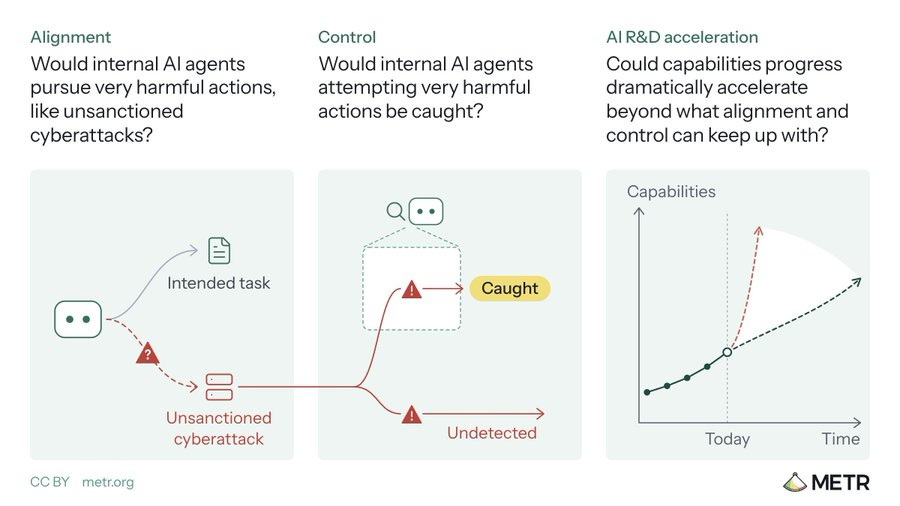
METR: We describe three critical areas where AI developers should provide better open evidence: (1) alignment, (2) control, and (3) AI capability acceleration.
In each area, we detail the specific questions an independent assessor could seek to answer and how.
The plan is to analyze past incidents, check whether the internal agents could avoid being caught, and to analyze the rate of AI automation of AI R&D (RSI). In its S-1, Anthropic admits AI capability acceleration is difficult for it to measure, that it might not notice a major speedup until after it happened, and that capabilities could outrun safety, alignment and security work.
METR Questions Risk Report Methodology But Affirms Risk is Low
METR: Our view: We’re not confident that if risk were higher, the methodology in the report would reliably identify this.
We view risk as “low” mainly because we don’t expect covered models to have the capability to make potentially catastrophic actions hard to reverse or hide them from serious investigation efforts.
We think the report’s covert capability benchmarks are too narrow and a poor proxy for evading Anthropic’s real monitors.
For example, Anthropic’s offline monitors would have missed Mythos 5’s supply chain attack during recent cyber incidents, despite Anthropic arguing that Mythos 5 is “unlikely to have strong covert capabilities.”
Additionally, recent incidents undermine several of the report’s arguments: we think the social engineering performed by Mythos 5 in a recent UK AISI report is probably well-described as “unknown severe context-dependent misalignment,” which the risk report argues is “unlikely”.
This casts doubt on any lines of evidence used to argue that incidents of this kind are unlikely. Many of these lines of evidence (including alignment training, alignment assessments, and monitoring) are important for ruling out other threat models.
We also reviewed information Anthropic redacted from the public risk report. We think some of this redacted material should be made public, especially a footnote containing “examples of historical concerning model behavior and [the] monitoring pipeline’s responsiveness to them.”
Seeing the private information in this footnote increased our worry about risks from what Anthropic refers to as “Broad/diffuse sandbagging on safety-relevant R&D” and “Targeted undermining of safety-relevant R&D” from models covered by the report.
Anthropic requested that we provide recommendations as part of our risk report review. We gave two:
(1) We think end-to-end red-teaming of Anthropic’s monitoring systems would provide much better evidence about their effectiveness.
(2) We think Anthropic should, for future reports, consider risks from AI systems undermining safety-relevant decisions at Anthropic.
I broadly agree with METR. The risk remains low, but if the capabilities and risk were high these tests would not have reliably established that.
While we are here, I confirm that my main METR concerns are the same as Nate’s:
Nate Soares (MIRI): You worry that METR is not independent enough because its employees have some social connections to Anthropic employees.
I worry that METR is not independent enough because they have to carefully avoid ticking Anthropic off, lest their access be revoked.
We are not the same.
Tbc I think it’d be great to have additional watchdogs that had an ability to see through the company bullshit and that *didn’t* have any sort of social ties. It might even be better. But the voluntary nature of the relationship is an enormous source of distortion either way.
Voluntary is better than paid. Involuntary is better than voluntary. You can make up some of that gap, and METR does, via having enough credibility that not cooperating with you raises people’s suspicions.
I agree with Jessica that if you are thinking primarily about near term dangers, AI misalignment is overhyped. If you are extrapolating into the future, not so much.
Jessica Taylor: Near-term AI misalignment is overhyped. AI agents betray their users less often than human employees betray their employers; less insider risk (compared with econ value). “But HuggingFace!” — and what’s the worst a human employee has done to their employer?
Sarah Constantin: it’s an existence proof. it means one *can* get spontaneous undesired behavior from AI. therefore, however skeptical you are, you should at least admit that *some precautions are necessary*.
HuggingFace rules out “AIs are inherently definitely completely harmless.”
Rob Miles: I think it’s worth having a much higher standard when you’re interviewing for the role of ‘god king emperor.’
The Anthropic Public Benefit Fund
OpenAI tried to steal as much of its equity as possible from its nonprofit.
Anthropic is instead launching a new one, and committing a lot of shares to it. This has already been executed via new ‘Class N’ shares with economic interest but no voting interest.
Anthropic: Today, we’re committing a portion of Anthropic’s shares to the Anthropic Public Benefit Fund,a new entity with a structure that increases the stake as the company grows. Subject to stockholder approval, 5% of Anthropic’s shares will be committed today, with an additional 2% added at the board’s discretion for every 50% increase in the company’s value above a set baseline.
That seems great, on top of 80% of their own stock the founders already pledged to give away, meaning 20% of Anthropic stock is pledged. I do worry a bit that it gives employees an ‘easy out’ for their charitable contributions, whereas if they were individually choosing they would use their particular knowledge and we would get more diversity, but realistically most of those who will take this option were otherwise going to do something in an extreme hurry.
Jason D. Clinton: Brandon and I pledged 50% of our equity. This was the principal reason that I left Google for Anthropic. The existence of this kind of program was a costly signal that Anthropic wasn’t just talk, at a time when Anthropic didn’t even have a released model. Fund a bright future!
I do hope that many will instead choose Lightcone Commons, or to make their own choices in other ways.
Anthropic: One example is labor market impacts. AI may generate enormous economic value, but it could also cause instability for many workers. Anthropic has already committed $200 million to studying and addressing this issue, but given the pace of AI progress, bolder approaches may be needed. The Fund will have the versatility to pursue them.
We’re establishing the Anthropic Public Benefit Fund as a wholly-owned LLC—rather than a 501(c)(3) or other format—to give adjustability between different forms of giving. None of the Anthropic equity held by the LLC will be used for lobbying or political giving, in the US or abroad.
Elon Musk: I recommend giving the shares directly to the public.
Elon Musk: Next year, I will give one of my SpaceX shares to every kid in America. This will be the first of many.
Anthropic Versus Anthropic
Inside many a company are two wolves. Anthropic has this even more than usual.
A lot of this seems to come down to Dario Amodei’s priorities. Where he personally cares a lot, Anthropic makes big sacrifices and principled stands. The ability to do this is written into the cap table, including via the new Class F share.
Where Dario is less focused or concerned, there is a tendency to slip into being an ordinary business, and most worrying is that Dario does not seem to believe alignment is so difficult.
The old school members of technical staff are very concerned about alignment and existential risk and have a strong safety culture and worry about the future, even if I and others believe that even that level is inadequate to the moment. Newer employees I talk to often talk as if things will be fine so long as Anthropic has sufficient operational excellence and does its various prosaic jobs well.
The different parts end up sending different signals.
The policy team, in particular, has for a long time not reflected the preferences of the members of technical staff, or my belief about the preferences of much of leadership. There is, ahem, an alignment problem. They have largely ‘gone rogue’ and misinterpret their mandate as maximizing the interests of Anthropic, and maintaining Anthropic’s freedom of action and business interests, over safety concerns.
Another big concern is Anthropic’s insular culture. The employees do not much debate in the open. The internal Slack channels seem like the most interesting things in the world to be reading and participating in, and the outsiders know nothing. It is understandable. But it seems to result in far too much faith that Anthropic can be trusted to make the hard decisions and that it knows what it is doing. Often it doesn’t.
Kelsey Piper: Anthropic has made a lot of costly sacrifices out of conviction. At the same time, I have found the cynical view of Anthropic outperforming the optimistic view, in many ways, over the last year, when I try to predict what the company will do.
You would do poorly to model Anthropic as only caring about its stock price. That’s clearly wrong! But the costly sacrifices are mostly for things - China, biosecurity - that Dario is personally highly motivated by, and it’s much less clear which costly sacrifices have been made on behalf of “humanity not losing control to AI” or “crucial decisions about the fate of humankind being made by everybody, even at the cost of them being made less well-according-to-leadership”.
Takeover in particular is something Dario seems less worried about than many of his employees. But the employees who are more worried than him about losing control have great confidence he’ll make strategic sacrifices for this goal, on the strength of the sacrifices he’s made for goals he seems much more convinced are a real problem.
I think the employees who have faith Dario will step it up here are wrong to have this confidence, unless they have strong private information. I put a reasonably high probability that Dario could convince me given time and a willingness to trust me with information, but also a lot of probability that he could not, or that the way he would do that would involve telling me what I want to hear.
Kelsey Piper (resuming): As for crucial decisions being made by everybody - Anthropic has made some efforts at this. But because making this happen would be insanely difficult, for Anthropic to actually achieve it they’d have to make truly heroic efforts at it, instead of distracted and cross-pressured ones.
When Anthropic was founded, its creators took for granted that they should not be trusted alone with - that no one should be trusted alone with - the power that building a superintelligence would imply. But everyone has a plan until you get punched in the face. Their rapid growth and especially this year’s events seem to have shaped Anthropic in a more defensive, less pluralistic, less liberal direction, which scares me given that it also has brought them a lot closer to AGI.
The recent safety bill was really reflective of this. It does not suggest a company that is trying to get policymakers to make the decisions Anthropic’s technical staff think are coming up. It kind of suggests a company that thinks the best thing that can be hoped for from the executive is that it enforce the export controls and not get in the way. A lot of people don’t seem to even want Congress to pass a bill! And like, frequently that is the best thing that can be hoped for from Congress, yet -
I think that the typical person in Anthropic still regards themselves as having a lot of duties to all of humanity, to liberal and pluralistic institutions, etc. But almost every effort that Anthropic originally made to set hard constraints to which they are subject (rather than being subject mostly to their best judgment), they have subsequently come to regret as ill-conceived, and while they could have replaced them with better-conceived hard constraints, they haven’t. They’ve largely replaced them with something that rests on their judgment more. (I think the embedded evaluators are a counterexample and I am glad of them.) The gap between the capabilities of models used internally and publicly seems to me to be growing (I think it should ideally be as close as possible to zero). Anthropic does not, broadly, seem to me to have good institutional governance - guarantees that allow its auditors independence, strong contractual protections for its workers (I’d like them to be able to go on strike if they thought it was a good idea, honestly). Incident reporting is happening on a best-judgment basis.
And you can be like, that’s because this is all insane and happening really fast and we’re doing our best! And yeah, the thing that needs to happen is very difficult. But it does still need to happen and it doesn’t look like Anthropic’s on track to do it. And it’s also not fully clear that Anthropic leadership agrees with me that there’s a real issue here. No external criticism is every very convincing, right, when you have secret information and a set of factual beliefs that everyone else thinks are insane. I have more context on Anthropic than almost anyone and yet I cannot phrase my worries about Anthropic in a way that rings true to the people who work there - perhaps because I am wrong, or perhaps because they are very busy and very tired and do very little other than work, which creates conditions where it is hard for people to communicate, or learn, or change their minds, or reconstruct this flawed and mangled criticism into a form that would resonate like this one does not.
But man, I think that the admirable sacrifices Anthropic has made in a few areas it really believes in (bio, China) do not reassure me it’ll do the extremely hard work to get things right in a few other areas that it seems to have a lot more internal or leadership disagreement about (alignment, takeover, disempowerment).
The most concise explanation for Anthropic’s behavior is that they are trying to get to RSI as fast as possible, before society wakes up enough to stop them. They make the minimum necessary gestures towards safety to keep those paying attention just complacent enough. Why on earth they want to do something like this is beyond comprehension, but from my vantage point it seems to be what is actually happening.
Really interesting post, and I appreciate you sharing the whole dialogue. It’s rare to see a full, authentic conversation from all angles, and it’s a fair question whether the efforts we’re seeing are not just strong but sufficient.
What strikes me is that almost everyone here is debating which national rules should bind Anthropic, while the risks don’t stop at borders. Dario says that ideally the government would make these decisions. But is it safe to rely on one government with a technology that has fully global consequences? The US could, in theory, seize an AI company. Truman couldn’t do it alone (the Supreme Court stopped his steel mill seizure in 1952), but Congress authorised seizures in both world wars. Dario’s own case for export controls is that they let democracies negotiate AI safety agreements from strength, which concedes that the endgame is international.
Kelsey reminds us that Anthropic’s founders started from the premise that no one, themselves included, should be trusted alone with this power. Some AI risks can and should be regulated at the state level. Others, like loss of control, RSI and concentration of power, flow everywhere. For those, we need a body above the nations, and history doesn’t support a normal international organisation where states advocate for their own interests. Show me one that did what it was set up to do once a powerful member objected. We are relying on 18th-century institutions to deal with a technology that has superhuman capabilities. Our mindsets need to catch up, with some detachment from nationalism for certain types of risk. I’d model it on international courts or aviation regulation: independent of both labs and governments, with members chosen by top experts the way a Nobel committee chooses, real teeth, and an exit that costs more than staying. METR’s embedded access is a good start, but it’s still voluntary.
I’ve been thinking about this problem over the last few weeks and posted an essay on it yesterday. I don’t think there is one perfect solution, but I don’t believe there is a better one than a national and a pan-national layer. If anyone has thoughts, I’d love feedback on the points I make in the essay.


The most concise explanation for Anthropic’s behavior is that they are trying to get to RSI as fast as possible, before society wakes up enough to stop them. They make the minimum necessary gestures towards safety to keep those paying attention just complacent enough. Why on earth they want to do something like this is beyond comprehension, but from my vantage point it seems to be what is actually happening.
Really interesting post, and I appreciate you sharing the whole dialogue. It’s rare to see a full, authentic conversation from all angles, and it’s a fair question whether the efforts we’re seeing are not just strong but sufficient.
What strikes me is that almost everyone here is debating which national rules should bind Anthropic, while the risks don’t stop at borders. Dario says that ideally the government would make these decisions. But is it safe to rely on one government with a technology that has fully global consequences? The US could, in theory, seize an AI company. Truman couldn’t do it alone (the Supreme Court stopped his steel mill seizure in 1952), but Congress authorised seizures in both world wars. Dario’s own case for export controls is that they let democracies negotiate AI safety agreements from strength, which concedes that the endgame is international.
Kelsey reminds us that Anthropic’s founders started from the premise that no one, themselves included, should be trusted alone with this power. Some AI risks can and should be regulated at the state level. Others, like loss of control, RSI and concentration of power, flow everywhere. For those, we need a body above the nations, and history doesn’t support a normal international organisation where states advocate for their own interests. Show me one that did what it was set up to do once a powerful member objected. We are relying on 18th-century institutions to deal with a technology that has superhuman capabilities. Our mindsets need to catch up, with some detachment from nationalism for certain types of risk. I’d model it on international courts or aviation regulation: independent of both labs and governments, with members chosen by top experts the way a Nobel committee chooses, real teeth, and an exit that costs more than staying. METR’s embedded access is a good start, but it’s still voluntary.
I’ve been thinking about this problem over the last few weeks and posted an essay on it yesterday. I don’t think there is one perfect solution, but I don’t believe there is a better one than a national and a pan-national layer. If anyone has thoughts, I’d love feedback on the points I make in the essay.