This post will update how I use Twitter now in 2026, and provide updates on the current state of the new algorithm, the situation with links, with the API, and some thoughts about using Twitter to make money which you almost never should try to do.
Previously I said you need four things to use Twitter well:
Tweetdeck or another similar alternative application.
Knowing who to follow and read.
Lists.
Unfollows, filters, mutes and blocks.
That hasn’t changed. Lists have become even more important.
This post is coming out now, however, because the For You feed is perhaps making a comeback.
Except where stated here, the advice in my 2022 post still applies.
Twitter now has three feeds other than lists. You can have the horrid ‘For You’ experience, or you can have the Following ‘Sort by Popular’ experience, or you can have an actual chronological Following ‘Sort by Recent’ but you now need to click on that second part manually.
That is rather hostile for those who want chronological feeds.
So I’ve been forced to migrate to entirely using lists.
I do see the appeal of the middle path of ‘algorithmic feed but only people I explicitly follow,’ if you are following more people than the number of Tweets you can consume and aren’t monitoring situations in real time. That seems reasonable for those who are not Twitter completionists, and want to drink from a curated but oversized firehose.
Previously I would use multiple lists for different topics. I had my followers, I had two lists for Rationalists and AI that I would check consistently, then lists for Economics, Politics, Sports and so on that I would check when there was a Situation to Monitor.
This shielded me from context shifting. I would think about AI in a block.
As AI has become ubiquitous throughout everything, keeping distinct lists mostly stopped being worth the trouble.
So now I have an ‘All’ list, which I created via my Chrome extension porting everything over. The All list combines the previous AI, Rationalist and following lists, and is everyone I want to always see. I am committed to reliably seeing all of it.
I do still have a few other lists, but they are not well maintained, and if the situation came up I would need to curate them again. I’m sure I will have to do that in 2028 for the politics list.
Block Early, Block Often, Know Your Triggers
Blocking used to be a big step, since the person would be unable to see your posts.
Now that blocking does not do that, I block at the drop of a variety of specific hats, including being an asshole, if someone has not previously demonstrated value.
One of those rules is AI slop. If you are going to give me AI text, or what might as well be AI text, it needs to be interesting, or you’re gone.
What I do my best to avoid is blocking mainly for having opposing viewpoints on topics I care about, even if done relatively obnoxiously. I need to avoid getting a distorted view of the landscape.
Lists Change What Following Means
I no longer look at the list of Tweets from my followers, at all. If I follow someone new, and I want to actually see their Tweets, I will also add them to the ‘All’ list.
For that purpose, I still use the old rule: Look at the history of their posts and assess the average quality or net value provided, per Twitter thread.
The list of things to watch out for also aged well:
Lots of stuff you don’t care about.
Self-promotion.
Spam.
Spoilers.
Not safe for work.
Misinformation.
Politics, especially political advocacy.
Just not that great.
Getting old fast.
Cancel bait.
You can overcome some amount of those, but you need to provide a lot of value.
For focused lists, you also want to ensure the person is focused mostly on the topic of the list, or would be when you have a Situation to Monitor.
This frees me to use following for all its other purposes.
Again, following is a package of six things:
People can see that you follow them.
They can DM you even if your DMs are closed, and perhaps you can DM them.
The posts you want from them appear in your feed.
The posts you don’twant from them also appear in your feed.
You see interactions between people if and only if you follow all of them.
If they’re locked it’s the only way to see anything at all.
We can add a 7th thing, which is that you can use your following list as a reference, to find those accounts.
If there is no feed, that knocks out #3 and #4, and my DMs are open so mostly that knocks out #2. So if I follow an unlocked account, it means some combination of: I want to see you within interactions, and I want to communicate that I am following you within the social game of Twitter.
That lets me in theory be a lot more liberal with who I follow, but for now I’ve instead chosen to be only modestly less selective, with only ~300 follows. I think I want to ideally be in the ~500 range.
It (Wasn’t) For You
Back in February, Stray noted a big shift in how much the For You page includes people you follow. Twitter used to claim in 2023 that this number was ~50%.
Jonathan Stray: I found a simple prompt for Claude Cowork that used my browser to figure out the percentage of posts in my For You feed that come from people I follow. This turned out to be 16%. I convinced two other people to try it, and they got 5% and 11%. (Try it yourself and leave a comment below!)
I got 27% in April despite having under 300 follows, based on an experiment at the time, but I am very precise with my engagements. For me 27% is not that high, and the algorithm had already been adjusted in between by the release of ‘Phoenix’ around April 1.
The old systems looked at the engagements of people you follow, along with grouping people into communities by interest areas. That’s the kind of perverse hidden system you need to be optimizing for. You’d want to primarily choose followers who engage in good ways.
Whereas the new code looks directly at which users engage with a post to predict probability of your engagement.
I notice that all these systems are trying to predict whether you will engage, rather than whether you will find value. This is a terrible proxy target, and forces you (if you want to use any algorithmic feeds) to choose interactions on the basis of them being training data. Don’t like anything you don’t want to approve for what is essentially RLHF.
It’s For You
There is an exciting development in Twitter’s For You page recently. Did they fix it?
Can all of your friends come back now?
I (and by ‘I’ I mean Sol) reran the experiment on my For You page today. People I follow were now 37% of the first 300 items in the feed, up from 27%.
That’s starting to be in a good place, given there are a bunch of people in the feed that I should be following under the new regime, but wasn’t yet. Overall, the feed looks like a vast improvement, and the acclaim seems universal. There is also improvement in the sorting of reply threads.
Nikita Bier (Twitter Head of Product): We're rolling out a small tweak to boost visibility of your posts to your mutuals (people who you follow back).
We noticed this data was missing from the algo and it made your friends appear less in your replies. This resulted in the reply section feeling more like a battleground with people you don't recognize.
This should also help clusters form around interests more easily, which many people have asked for.
QC: did he actually do it? did he restore simclusters? can we bring the golden age back???
ok now I’m going to be a bit contrarian and say that while I love my mutuals I don’t want to see only posts from them, which is what’s happening rn. having a bit of a mix between explore/exploit is genuinely good
one day the algo will consistently remember that I like having a bit of high-quality furry art mixed in with posts from people I follow and high-signal posts from elsewhere
sometimes it gets close, but it always seems overtuned one way or another
spor: my own feed is suddenly feeling the most ~mutual~ it has felt in like over a year, i swear. it's as if the fog has lifted and i am discovering you all again, anew. welcome back everyone.
Romy: my feed is suddenly 90% ppl i follow and it feels like walking into a party where i know everyone. one time i went to the venice beach boardwalk and saw a guy eating glass for tips and another guy with a two-headed turtle in a bucket that he was charging $5 for ppl to look at. anyway previously my feed felt more like that.
Daniel: Lobster too buttery etc but literally every tweet on my for you now is a mutual, like what’s even happening on the larger website
PoIiMath: I'm having the same experience. It almost makes me want to follow some more normie news accounts b/c my entire feed is finally filled with my favorite weirdos.
Daniel: Yeah. Give me a few site wide bangers that have topic similarity to my liked posts.
I definitely am nothing close to 100% mutuals or even 100% follows. I wonder if increasing my followed count would change this; Daniel follows over 4,000 people, Sonya over 2,000, which makes being a completionist prohibitive.
I now think that, if you are fine not being a completionist and you have strong discipline in what you engage with, the current For You feed is playable. In terms of value per Tweet, if consumption is light, it plausibly exceeds the value of my All list.
The problem is that if you are trying to be a completionist, the For You page does not allow that, and if you combine it with a list then you’re going through a lot of duplicates. So ultimately I don’t think it makes the cut for me even if it stays good.
The Previous Time Twitter Transformed Its Algorithm Again
Then again, maybe it didn’t, not much. Has Grok been running Twitter’s algorithm as of January? Not exactly. It is by reports using a transformer architecture. They said they would open source the algorithm, and to some extent at least they did do that. It’s grim out there.
I don’t know the extent to which this section still holds. It could change at any time.
But the thing is, a lot of the values reported here as of January were still the same as they were in 2023. Both of these seem to reflect only the old system:
Bark (January 20, 2026): I read the code so you don’t have to. here’s the breakdown:
1. reply to your comments. the algo weighs “reply + author response” 75x higher than a like. ghosting comments = strangling reach. 2. links kill visibility. put them in bio or pinned. never in the post. 3. watch time is king. if they scroll past, you lose. video/threads win because they stop the scroll. 4. stay in your lane. “SimClusters” are real. if you drift out of your niche (crypto, tech, etc), you get zero distribution. 5. blocks/mutes nuke your score. be polarizing, but don’t be annoying.
TLDR: talk to your audience, build relationships, keep people on the app. it’s actually very simple.
Every account has a base score that’s applied before a tweet is evaluated.
Verified accounts: +100 automatically Unverified accounts: up to +55
That base score is then multiplied by: Your follower-to-following ratio (only meaningful if it’s very poor) Your restriction status
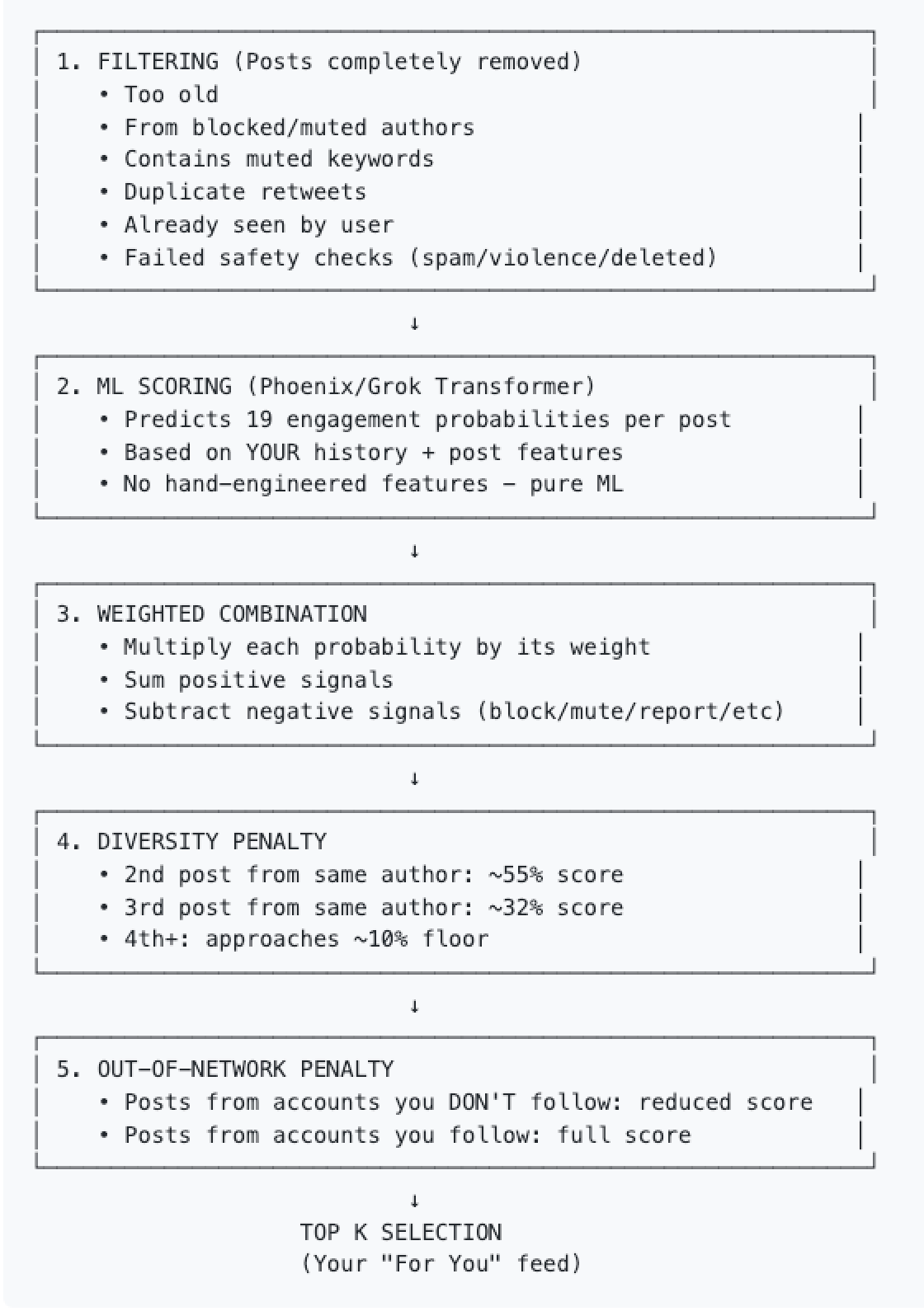
There are no manual engineering rules anymore. Grok fully determines the algorithm.
Your post lives or dies in the first 30 minutes, driven entirely by velocity:
0–5 minutes: Shown to ~5–10% of followers + a small out-of-network sample 5–15 minutes: If engagement is strong, shown to 20–30% of followers and a larger OON audience 15–30 minutes: If performance holds, the post enters For You feeds at scale
Older posts don’t get a second chance. They’re trimmed out and replaced by newer posts with stronger velocity signals.
Engagement weights:
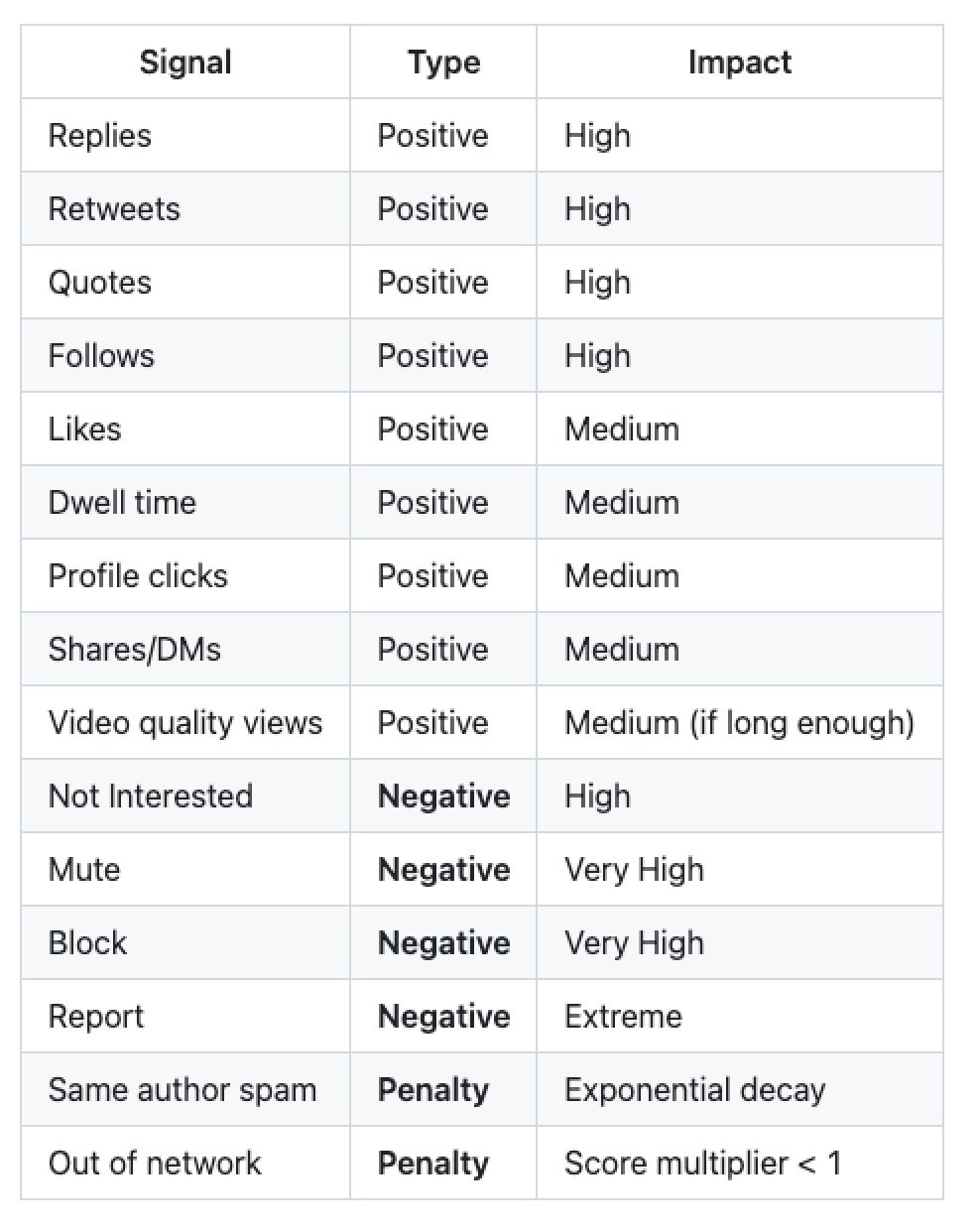
Author-engaged reply: +75 Reply: +13.5 Profile click: +12 Repost: +1.0 Like: +0.5 Report: −369 (instant death) Video performance is negligible — even 50% completion is only +0.005
There is no “relevance” ranking between posts. The score is the score — it doesn’t adjust based on what’s trending or what else is in the feed.
Reposts being only +1 still seems utterly insane to me, the same as it did in 2023, as did the +75 on replying to comments. A repost should be a vastly stronger signal than almost anything else, no? Or perhaps they’re thinking the direct repost impact is already enough on its own.
Engaging with all your replies is the most obvious thing to do. So always engage? I tried that for a while back in 2023. It is helpful if you are at small scale, but feels like it gets drowned out at large scale.
Here’s another analysis with some other basic findings: Spread your Tweets out over time. Don’t post old content or duplicates.
How well is the new algorithm working? Reports are that it isn’t great.
neurotica: I am genuinely amazed how bad nikhita fucked this place up. I’ve lost the urge to scroll. Wild.
neurotica: Follow up: timeline was neutral this morning. Saw maybe one or two penguin posts. Liked the actual pic when I saw it. Feed INSTANTLY became 80% penguinposting. It’s so unstable lol
They definitely are doing some new things, including being way more responsive to engagement, but the core looks like it is largely the same as always.
Twitter Still Hates Links And That’s Terrible
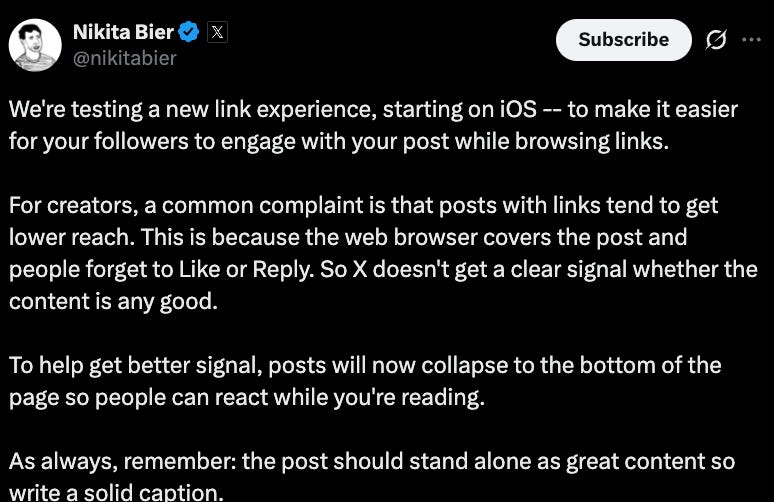
They claim links are ‘no longer deboosted’ but no one actually believes this in practice. It might or might not now be nominally true but they functionally severely punish posts where people actually click on the link.
Do I still spend a lot of time on Twitter? Yes, because there are no good alternatives, and it impossible to do my job without it, and if you spend enough time on list cultivation and doing good blocks you can get something reasonable.
But yeah, Twitter is way way worse than it could be, and the trend is downwards.
Twitter also introducing a $0.20 fee in its API for tweets with a link in them. There is no way to read that other than as a ‘f*** you,’ even if such Tweets are not otherwise explicitly downweighted.
Nikita Bier (Twitter Head of Product): Links are not deboosted. We fixed that issue last year.
Nate Silver: That isn’t really what the tweet you’re self-quoting says. It says it’s hard to establish the quality signal associated with a link and so each tweet should “stand alone”, and also the platform design makes it hard to engage with such tweets. Maybe fix that?
It seems e.g. like lots of people clicking on a link would be an unambiguous signal of engagement. It’s *off-platform* engagement, and you guys have the right to deprioritize that. But that’s what Facebook did, and it made them literally completely irrelevant to the news convo.
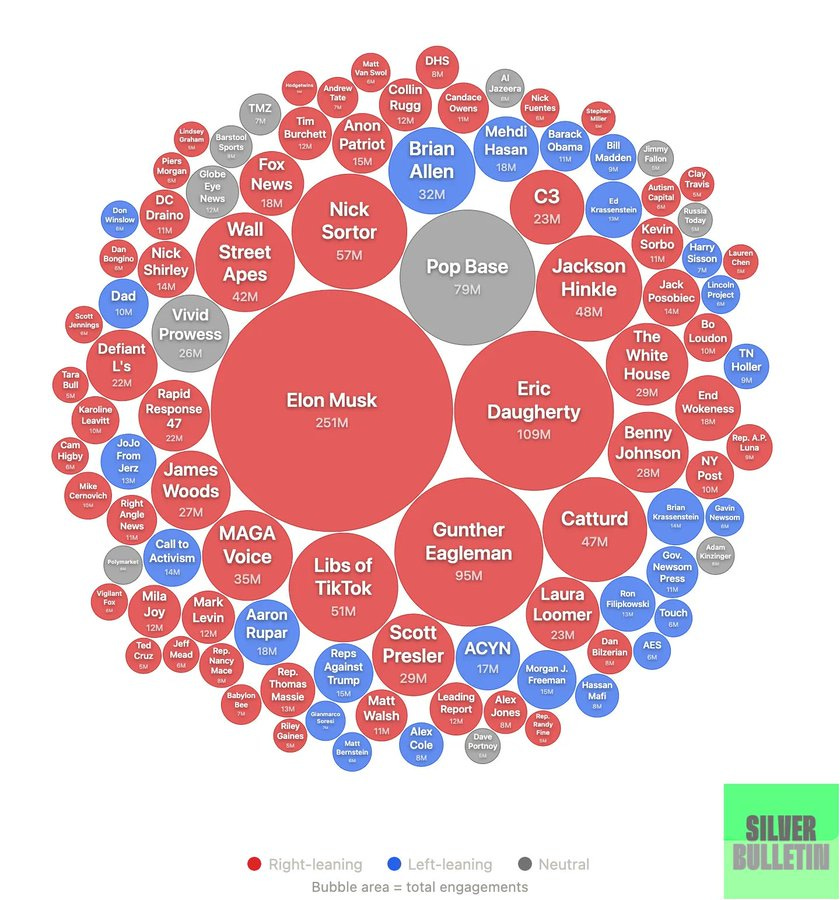
Nate Silver: These are the Twitter/X accounts with the most engagement so far in 2026. I suppose I had some intuition for how bad it was, but jeez, this is what you get when the ecosystem is broken.
Justin Wolfers: It is utterly dispiriting how few of these bubbles are reliable sources of information.
Nikita Bier (Twitter Head of Product): Data isn’t accurate. Missing half the network.
Nate Silver: It’s not my data. The source is Cluvio, which is linked to in the article. I’d link to it in this tweet, but ironically, that would kill engagement. And I know that traffic is hard to count. Especially for a private company. But if you have more accurate data, then publish it.
Do you think that X is facilitating high-quality information? If you suppress external links and there’s no real quality signal other than engagement, and people aren’t even getting so the accounts they follow so much as the algo, it seems like this is about where you’d end up.
The NYT published a link to critical original reporting on Iran 45 minutes ago. A good, fair story. They have 53m followers. The engagement metrics you display say they got 94 likes and 33 retweets out of that. Is that accurate? And if so, shouldn’t you work on a better algo?
Nikita Bier (Twitter Head of Product): It’s paywalled. If only 0.1% of users can derive value from the content, it will organically rank lower.
Alan Cole: Dumb. The value of the link is in backing up the claim. The claim can often be backed up from a NYT/WSJ/Bloomberg headline alone. But it’s also a signal you’re willing to let the many power users who do have subscriptions investigate the story further. Dumb dumb dumb.
Do you know how I know users value NYT/WSJ/Bloomberg? Because the engagement maxxing accounts (I’m not a fan, but they know what works on here) still cite them for credibility. But you have “trained” them to not provide the link because they know that harms their engagement.
What you’ve taught them to do is say “I promise, really, I read good news sources, you know the ones, and here’s what they say. However, I don’t want to be thrown into the gulag by Nikita, so please just accept my word for it that a link exists.” Dumb dumb dumb dumb dumb.
One in twelve American households has a NYT subscription, as do (presumably) a much higher percentage of followers of the NYT account. Yet approximately none of their followers are being shown the content, and Bier doubled down on essentially ‘they should be figuring out how to optimize for engagement, rather than offering a news service that allows people to choose when to access the news, so it’s on them.’
Nate Silver: There’s nothing organic about it; it’s deliberate choices you and the team are making. And although those choices may have been defensible in the abstract, they’re clearly resulting in low-quality content rising to the top. You’re a smart dude, you can build a better algo!
Nikita Bier (Twitter Head of Product): Can you stop quote tweeting without the context? It’s intellectually dishonest.
Elon Musk: Nate is a huge retard.
Stephen Is My Name: CAN YOU STOP USING MY PRODUCT ACCORDING TO THE WAY ITS DESIGNED IT BREEDS DISHONESTY
BuccoCapital Bloke: The algorithm destroyed the reach of replies, so why would he respond to you that way? Can’t be mad at people responding to the incentives of the system
Nate Silver: In what sense is it intellectually dishonest, Nikita? The context is clear. My thesis is: I think your algo surfaces too little quality. And I think your excuses in these back-and-forth exchanges have been validating of that. To your credit, it’s clear enough you agree with me.
Elon Musk: It’s surfacing you to me right now, which is evidence for your argument
Mike Solana: seems true that quality has degraded across the social internet, which is partly a structural issue. but it’s also true that huge media brands like the NYT are just really bad at social. when they aren’t boosted, they fail. they have the resources, they should adapt.
for example, given we know links are deboosted (this is denied but like, come on lol) why is the NYT posting a link to a paywalled article and calling it a day? yes, links are great... but we are also all free to produce native content.
Philippe Lemoine ran a little test and believes that while links were throttled around 2023, and then completely nuked, this reversed in spring/summer of 2025. Such posts still do poorly because the system measures things that de facto throttle links anyway, but you no longer pay an additional hardcoded penalty on top of that, and posts with links now do occasionally go fully viral.
As Nate says, a lot of the individual changes to the Twitter algorithm have been good, or at least locally defensible. In many cases I have been impressed.
But the big picture decisions are the ones that matter most. What are the incentives? Do they favor quality content, or do they favor slop? In what ways?
Twitter heavily tries to force users into the ‘For You’ algorithm, and heavily rewards ‘active engagement’ in the form of replies.
The combination of these means that to go viral, you need to provoke a bunch of people into responding. I’ve hit upon the magic formula a few times, and it always involves being at least a little bit toxic, leaving room for people to tell you that you are wrong in some way, or express their strong opinion. A lot of great content, including my blog posts, simply doesn’t do that. People don’t even ‘like’ my long posts there.
(In all seriousness, if you’re on Twitter and you’d like to help me raise my visibility, shoot off replies to my articles there as it has an outsized effect. Ideally make them thoughtful ones. Surely something came to mind at some point.)
If you combine that with throttling links for years and even now using metrics that effectively still do it (if you leave the site to read the link, the post is punished, even if it’s long term good for Twitter), and basically not caring about who is following who, and the way people respond on the margin, you end up with a giant pile of slop. Even if it’s not technically written by AI, it might as well have been.
Nate notes that the biggest changes to Twitter for the worse came exactly with the changes to the algorithmic feed in March 2016, predating Elon Musk’s takeover, and he notes it may have been one of the forces driving groupthink and wokeness into overdrive around that time.
If we want to keep everyone on an algorithmic feed, while solving or at least mitigating the slop problem, there are various ways to move in that direction.
The most obvious is to give more priority to people you follow, and to accounts where you’ve otherwise indicated interest.
Next up would be, how about we stop maximizing for ‘active’ engagement and start optimizing for ‘positive’ engagement? Grok exists. Grok can scan every reply or quote tweet, and ask whether it indicates the person is happy that the OP exists, or if they are sad. It should be very good at that. If you’re getting negative engagement, I am sorry, but that is actually bad, not good. Penalize it, or at least reward it a lot less.
A third idea would be to actually train a slop or engagement bait classifier. This is not as difficult as it sounds. I am confident that those creating tests for AI-written text could also identify slopolicious text using the same principles.
A full solution involves reimagining what you are aiming for, and realizing you want to be the front page of someone’s internet, their central hub, and providing value to keep them coming back. And that if someone wants New York Times articles in their feed it should be obvious that you should provide that.
Twitter Turns Its API Back On
Twitter finally lets you pay per message or action for the API as of February.
Developers: Officially launching X API Pay-Per-Use
The core of X developers are indie builders, early stage products, startups, and hobbyists. It’s time to open up our X API ecosystem and instill a new wave of next generation X apps. We’re so back.
The only reason it was previously so over was Elon Musk chose to make it over. Glad we’re back, although I notice I wouldn’t trust this ability to stick around.
The cost structure they started with was bizarre. They let you send a DM for $0.015, or create a post for $0.015, so you can spam and have your AI post on the cheap. However, if you want to read Tweets at scale, at the time that costs you $0.005 per Tweet, and if you search it is $0.05 flat fee plus the $0.005s.
A dollar lets my AI read 200 Tweets, which in theory is playable, but then they threw in a $0.20 fee per Tweet with a link, which is an absurdly prohibitive level of taxation. Don’t tell me they’re not throttling links, and this makes ‘parse my Twitter feed’ completely not viable. So you cannot do at a reasonable price here is fully Monitor The Situation or do any form of statistical analysis or deep dive.
I would instead charge a lot more for posting or DMs, especially DMs to accounts that have not yet replied to you, as a bot defense, and be generous with reading Tweets. To not do this suggests Musk is not so opposed to bots, but does fear you parsing the content.
Frank: X just revamped their API to finally be useful
So I made a skill that searches X, modeled exactly like the native Claude Code research agent
I’ve been asking like “find best clawdbot skills last 24hrs” or “what are people saying about [ticker] today?”
The examples I gave are pretty simple but you can obviously use it to find specific latest best dev practices, interesting uses of new models, summarize narratives about certain tickers, all kinds of stuff.
This has made using CC/OpenClaw 20x more useful over last 24hrs so far.
Frank: Words can’t describe how nice it is to finally be tapped into the Twitter firehose. Previous versions of this stuff were heavily limited by being glorified web scrapers.
Now... everyone has access to efficiently query all of Twitter. Insane. Thanks @XDevelopers
There’s no way this was actually a 20x thing but yes good Twitter search will enable some very interesting Claude Code and OpenClaw use cases.
What about reading your entire Twitter feed, or a wide range of Tweets and assembling it into something else? A dollar gets you 200 Tweets. Having this process my true Twitter feed might cost on the order of tens of dollars a day.
That seems… expensive, eminently payable, if the processing on it is good enough that you can actually filter large amounts of it out, or for broader searches reliably filter the good things in. One’s hourly is high. Interesting.
Many Of The Bots Are Human
A problem with identifying many bots is that humans do some very bot-like things.
derek guy (on Twitter): the one conspiracy i believe is that this place is full of bots programmed to say insane, incendiary things and they’re funded by foreign organizations who want to divide americans and destabilize US society
Nikita Bier (Twitter Head of Product): When I first started at X, this is one of the things I did a deep dive on because I felt it was critical to the integrity of the experienced. I tasked our Threat Disruption team to investigate a number of trends that seemed artificial.
The findings:
We could not find meaningful examples of foreign interference in US policy discussions, except people gaming rev share in developing countries. This is what motivated the release of the Country of Origin feature and significant changes to the rev share algorithm.
The most deranged & divisive replies generally were from residential IPs in the United States—with no signs of using a VPN.
Ultimately, X is a reflection of the internet. And that means you will see the full spectrum of human thought. And sometimes the most outrageous takes will catch fire.
Having said all of this, there can still be cases of narratives being boosted but the origin of the initial post is almost always domestic and we have hardened our systems in the last 3 months to prevent this.
Ryan Tyndall: So wait, you’re saying that people are really THAT dumb and ridiculous??
Nikita Bier (Twitter Head of Product): Sadly, yes.
Deranged liberal takes: Portland & Berkeley IPs
Deranged right-wing takes: Ohio IPs
solst/ICE of Astarte: Blizzard employee once told me anti-botting in WoW was extremely challenging due to the number of real people that acted identically to bots.
Every assumption was invalidated: - unbelievable # of consecutive hours played - consistently repetitive patterns of movement and clicks - farming patterns that aren’t considered fun (“why would anyone do that”) - solo, no external engagement - goes on for months
The problem with botting is many humans ARE bots
GrapeApe: moot originally hired me to deal with a bot on /r9k/. Turns out it was a guy with an inoperable brain tumor that reduced him to a husk of a being who could only make the same posts over and over again every day.
There are a lot of people out there who need to get an MRI.
It is extra hard in a game like World of Warcraft because of what peak farming performance looks like. The human and the bot are going to look the same. On Twitter there should still be meaningful differences.
The Rise of Slop
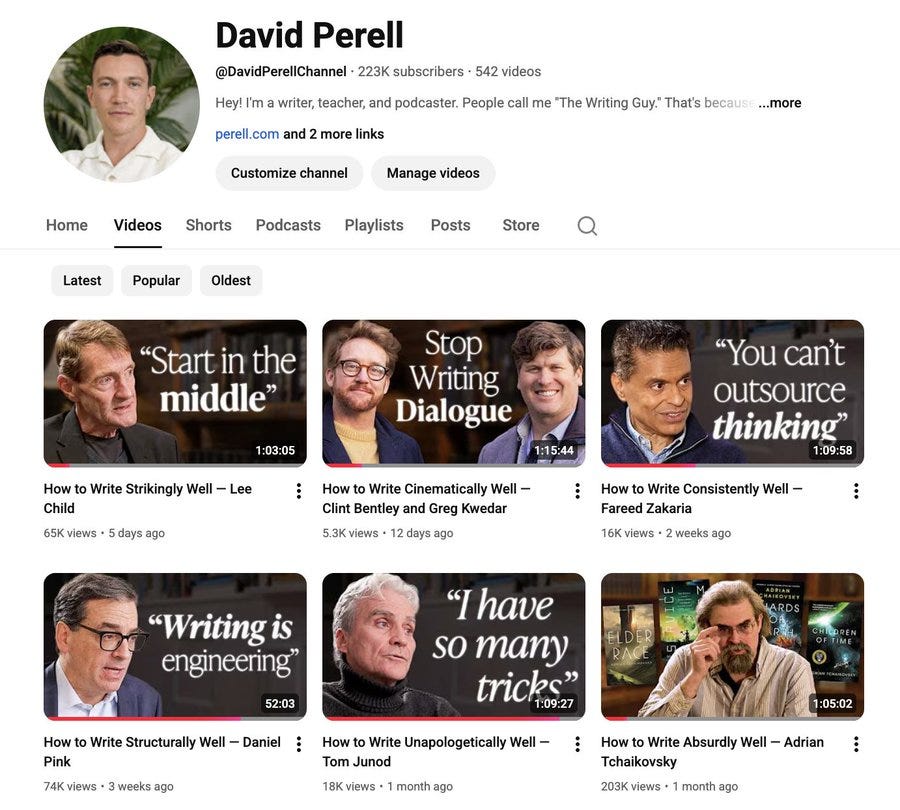
When algorithms have a ‘right answer’ it’s like when a game has a correct strategy, or a Magic: The Gathering format has a clear best deck, and everything collapses. We see this on Twitter with what I call the Twitter Slop writing style that clearly wins, and David Perell has a similar problem with YouTube captions.
I note that he knows a lot about good writing and wants to write well, and thus his post here is him walking the line between ‘the things that make Twitter slop effective’ and ‘avoid making the whole thing Twitter slop.’
David Perell: The state of the Internet in a nutshell: For 2.5 years, whenever I published a video on YouTube, I’d come up with a bespoke title / thumbnail that accurately described what the conversation was about.
Then, during the summer, my view count fell. Nothing worked until I found a formula: “How to Write ________ Well.”
Always the same text. Throw an adverb in the middle, then share a quote from the interview in the thumbnail. People are 0.5% - 1% more likely to click on that title format, so the channel has exploded in growth.
This title format is worse for my viewers and soul-deadening for me, but it’s leading to so many more views that I’d be crazy not to follow it — and people are significantly more likely to click on videos with the formulaic title.
This isn’t just a story about YouTube. So much of the Internet works like this now.
When I first got paid to write full time, Tyler Cowen gave me some top tier advice: That I could be more popular by making my writing stupider, but I shouldn’t do that. And indeed, as frustrated as I often am with him, Tyler always lives by that code. He might be trying to advance an agenda, sometimes on multiple levels at once, including via negativa, but he never makes his writing stupider or maximizes for reach.
I admit that if I found something that consistently worked and grew my reach as much as the trick Perell found, and it had a similar price to be paid (e.g. titles and thumbnails only, the core content didn’t change) that I would do it too, even though my view counts and subscriber base are holding steady or slowly growing.
Block Or Do Not Block
Basic social media etiquette, if you violate this it’s a huge red flag and black mark:
roon: one of the most cowardly things you could do is have blocked me but continually browse my tweets anyway and post screenshots misinterpreting them where I can’t respond over many months and years. just putting that out there
Aella: it’s so dumb when ppl do this. We should have a hall of shame
If you’ve blocked someone then with notably rare exceptions for Actually Important Tweets Within The Discorce you need to leave them alone. If they blocked you, a good portion of that should apply even then, although of course that’s your call.
Similarly, do not hide replies unless you are willing to outright block, and doubly do not hide replies of those you mention or tag, even if you are willing to block. Doing so is ‘I block you as a third party if I notice’ levels of unacceptable.
Straight retweets are endorsements, period. If you retweet a news item you are endorsing that the news happened and matters rather than that the news is good, but if you retweet an opinion that is an endorsement.
Quote tweets are allowed. It is on you to avoid giving a wrong impression out of context when you do so, but also this is Twitter so if your tweet gives the wrong impression out of context then that is also on you. Play better.
How To Make Money On Twitter
My advice is ‘don’t.’ Alternatively, here is one user’s advice on earning money on Twitter, playing the game straight. I don’t understand his advice to remove bot or inactive followers, yes they don’t add value but do they subtract value? As far as we know there isn’t any punishment for having those extra inactive or worthless followers, but perhaps it hurts engagement rates? He spends about half-time on Twitter and earns $400 per two weeks, which is indeed a lot more than I get paid despite having a lot more followers, but I’m not trying.
The other half is that you have to ensure you still get paid at the end.
Twitter effectively has a two-tier post reward system.
First there’s the system that decides who sees the post.
Then they decide how much to pay you for it, if it does well.
Most users care mostly about the first system, but others are there for the money, and they’ve figured out some tactics that work.
Twitter’s philosophy is now that they won’t mess with your free speech in terms of reach, but they will absolutely decide to not pay for your slop.
Nikita Bier (Twitter Head of Product): All aggregators had their payouts reduced to 60% this cycle. We will add another 20% deduction in the next cycle.
It became abundantly clear: flooding the timeline with 100 stolen reposts and clickbait everyday crowded-out real creators and hurt new author growth. The next step is to assign a permanent deduction to habitual bait posters who use “BREAKING”on every post.
Twitter will never infringe on speech or reach—but we will not compensate for manipulation of the program or our users.
They went on to cut this at least a further 20%.
I would be completely fine with throttling the related posts and accounts straight up, if I was confident that this was all they were doing, but that is a slippery slope. So I am here for ‘fine if you want to game the system like this we can’t stop you but we will absolutely cut your payments.’
I suggest also giving users the option to see when this is happening. That both guards against the system being used unfairly, since we can check the judgments ourselves, and also lets us notice this and block the offenders.
In general, the people who are ruining our collective experience are not hard to identify, nor are the posts involved. The question is about the will to act, and it is about trust.
Twitter only has ~6.5m paying users, because if you don’t post and don’t know to want Tweetdeck then paying does little. Most posts are by paying users, but most users do not pay.
A good idea:
Elon Musk (July 5): Users who interact with a misleading post that is subsequently corrected by @CommunityNotes will receive an 𝕏 Chat message of the CN to correct any misperception.

I worry that Twitter is manipulating you to think you should be on Twitter. Maybe you should be, but that doesn't seem obvious to me
I appreciate that you commit 100% to calling it Twitter throughout, with not even a nod to "X", and even give his title as "Twitter Head of Product".